




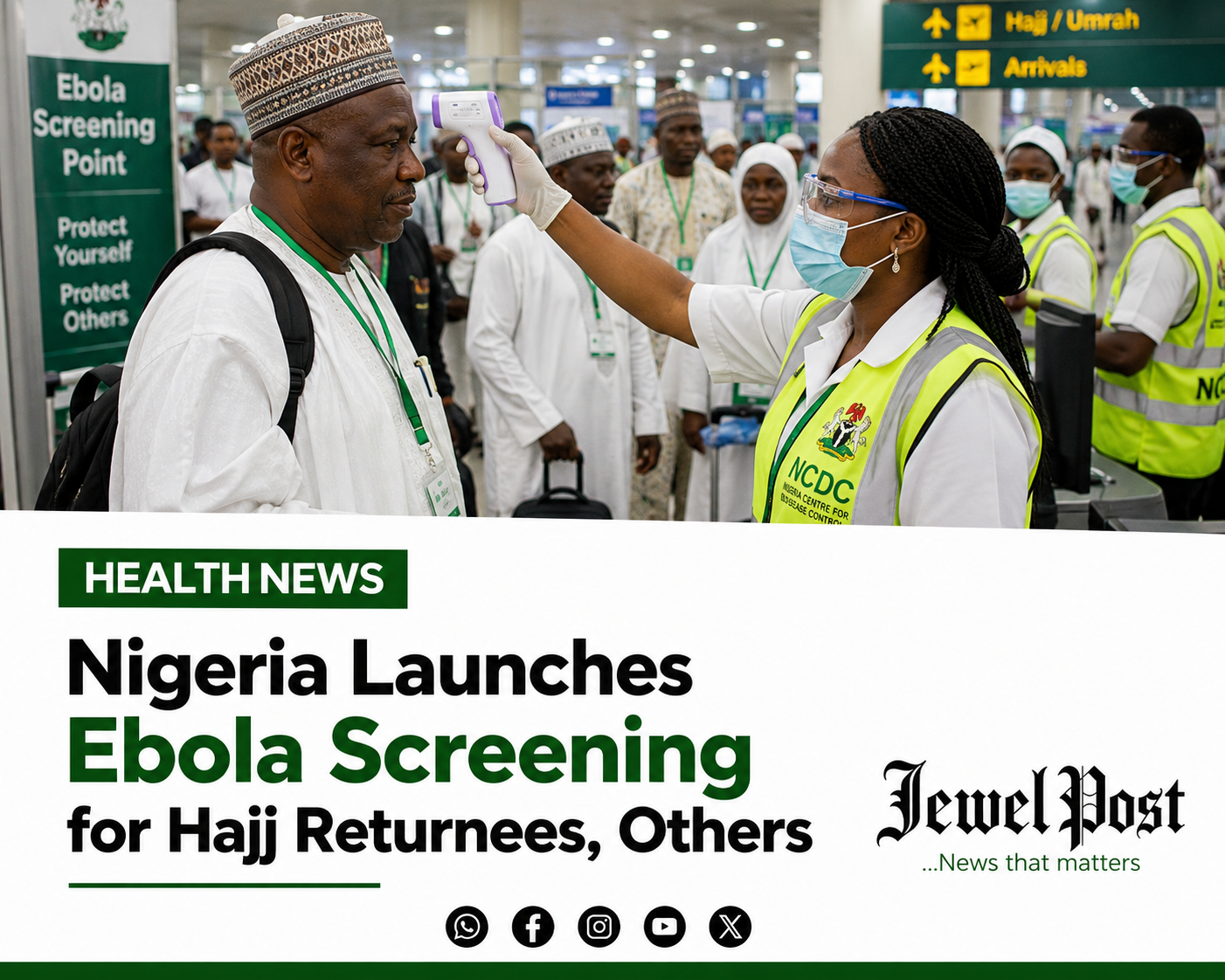
Nigeria Launches Ebola Screening for Hajj Returnees, Others
By Abdulrazaq Mungadi
Nigerian authorities have introduced mandatory Ebola screening measures for returning Hajj pilgrims and other international travelers as part of efforts to prevent the importation of the disease amid an ongoing outbreak in parts of East Africa.
The Nigeria Centre for Disease Control and Prevention (NCDC), in collaboration with aviation authorities, has intensified surveillance at international airports ahead of the arrival of thousands of Nigerian pilgrims from Saudi Arabia, expected to begin on June 4.
Under the new protocols, all passengers traveling to Nigeria must complete an Ebola Health Declaration Form before boarding their flights.
The measure follows the World Health Organization’s declaration of the current Ebola outbreak in Uganda and the Democratic Republic of the Congo as a Public Health Emergency of International Concern.
Director of Operations, Licensing, and Training Standards at the Nigeria Civil Aviation Authority (NCAA), Don Spiff, said the health declaration requirement is now mandatory for all inbound travelers.
Authorities said special arrangements have been made to assist returning pilgrims who may have difficulties completing the online form, with support to be provided by tour operators, NCDC officials and airport medical personnel.
Enhanced screening procedures, including temperature checks and health assessments, are already underway at major international airports in Lagos, Abuja, Kano, Port Harcourt, and Enugu, which will receive Hajj returnees.
The NCAA has also directed all international airlines operating into Nigeria to ensure compliance with the health declaration requirement. Passengers unable to complete the form electronically will be allowed to do so upon arrival.
Managing Director of the Federal Airports Authority of Nigeria (FAAN), Olubunmi Kuku, said no Ebola-related case has been detected at any Nigerian airport but noted that surveillance and monitoring have been significantly strengthened.
Health authorities say the measures are designed to protect the country from a possible importation of Ebola, drawing on lessons from Nigeria’s successful containment of the 2014 outbreak.
