












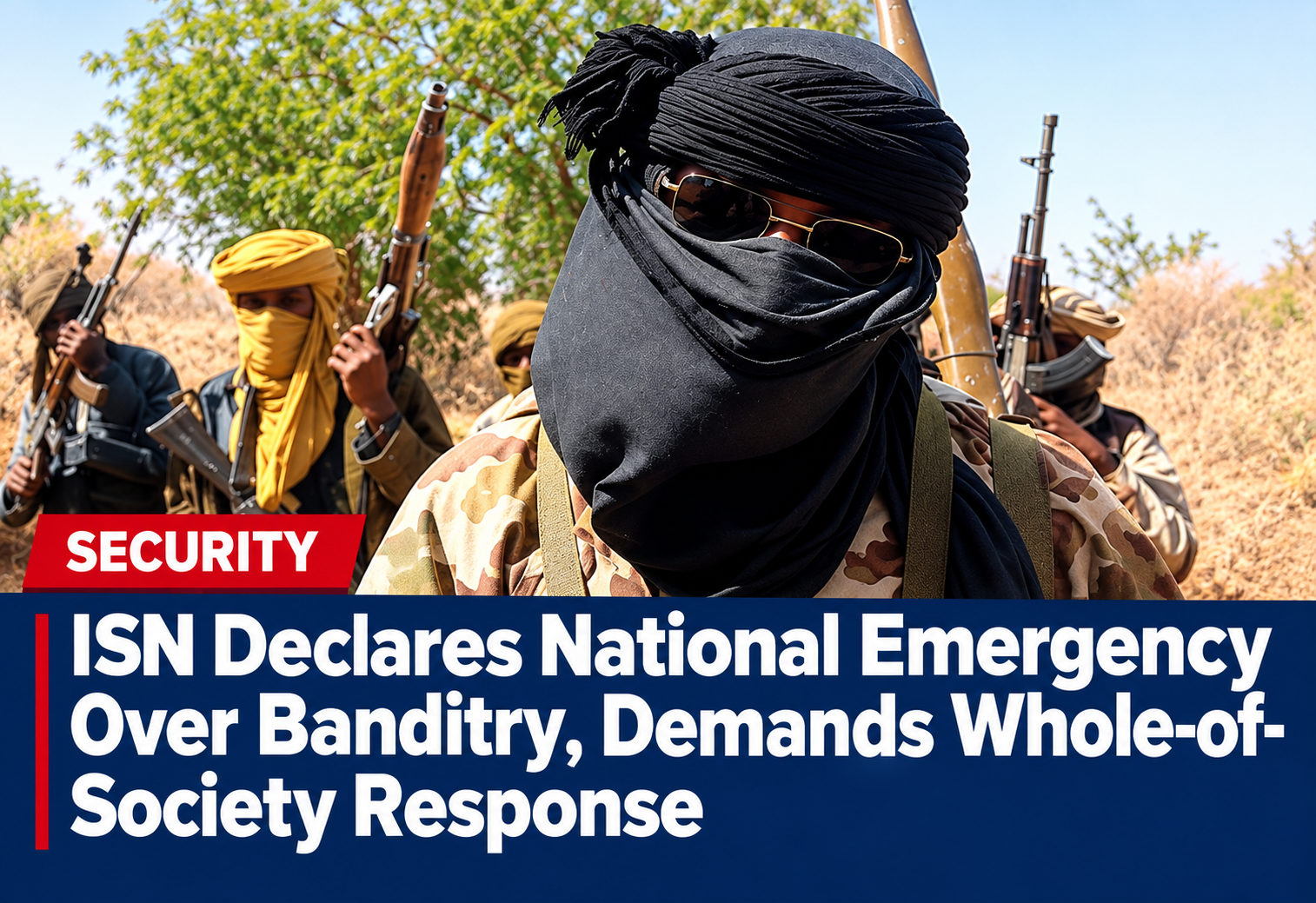
Banditry Now a National Emergency, ISN Warns as Criminals Impose ₦50m Levy in Zamfara
By Ahmad Umar
The Institute of Security, Nigeria (ISN), has declared the country’s worsening banditry, kidnapping and violent crime crisis a national emergency, warning that criminal groups are increasingly building parallel structures that threaten Nigeria’s security and economy.
The institute raised the alarm following reports that residents and traders in Talata Mafara, Zamfara State, were allegedly ordered by non-state actors to pay a ₦50 million levy and provide 100 livestock within seven days.
ISN described the reported ultimatum as an “act of war” against the Nigerian state and said the development demonstrated the growing audacity and organisation of criminal networks operating in parts of the country.
In a statement issued on Friday, the Deputy President and Chief Executive Officer of the institute, Barrister Adebayo Akinade, said the security situation had moved beyond ordinary criminal activity and required an urgent, coordinated national response.
According to the institute, continued attacks on communities, farms, markets and other sources of livelihood pose a direct challenge to the government’s constitutional obligation to guarantee the security and welfare of Nigerians.
The ISN said Nigeria could no longer depend solely on military operations to confront the threat.
“Kinetic operations alone cannot defeat this threat. A whole-of-government and whole-of-society approach is urgently required,” the institute said.
It called on the federal and state governments to treat the imposition of illegal levies, attacks on markets and related criminal activities as terrorism and economic sabotage.
The institute also recommended the creation of a coordinated security framework linking federal security agencies, state security outfits and properly vetted community guards.
ISN further urged increased investment in tactical mobility and surveillance equipment, including drones, night-vision devices and attack helicopters, particularly in frontline states such as Zamfara, Katsina, Sokoto, Niger, Kaduna and Plateau.
To help communities devastated by violence, the institute proposed the establishment of a Special Victims Support and Livelihood Restoration Fund to provide assistance to victims and revive businesses and other economic activities disrupted by insecurity.
For security agencies, ISN recommended a stronger focus on intelligence gathering and predictive operations, including efforts to infiltrate criminal networks operating around markets and livestock-rustling routes.
It also called for the dismantling of criminal supply and levy networks, the revival of regulated livestock markets and the introduction of a two-hour rapid-response system backed by visible air patrols.
The institute stressed the need for specialised training for security personnel in terrorism studies, intelligence management and counter-banditry operations.
At the community level, it urged traditional rulers, farmers, traders, market associations, religious groups and civil society organisations to strengthen early-warning and early-response systems.
Communities, it said, should document attacks, preserve evidence, support victims and promptly report threats through recognised security channels.
The ISN also cautioned citizens against paying ransoms or illegal levies to criminal groups, warning that such payments could further strengthen the networks behind the violence.
Among other proposals, the institute called for the establishment of a National Security Fusion Centre, state-level coordination desks and special courts to handle terrorism, banditry and kidnapping cases.
It also advocated the use of technology, including geo-fencing, livestock tracking systems and citizen-reporting applications, to improve surveillance and intelligence gathering.
The institute said it was prepared to support the government, security agencies and communities through research, professional training, policy advisory services and security certification.
The statement was signed by Barr. Adebayo Akinade, DFISN, FSCS, PSC, Deputy President and Chief Executive Officer of the Institute of Security, Nigeria.
The ISN said only a united response involving government institutions, security agencies and citizens could reverse the growing threat and restore public confidence in the country’s security system.


