




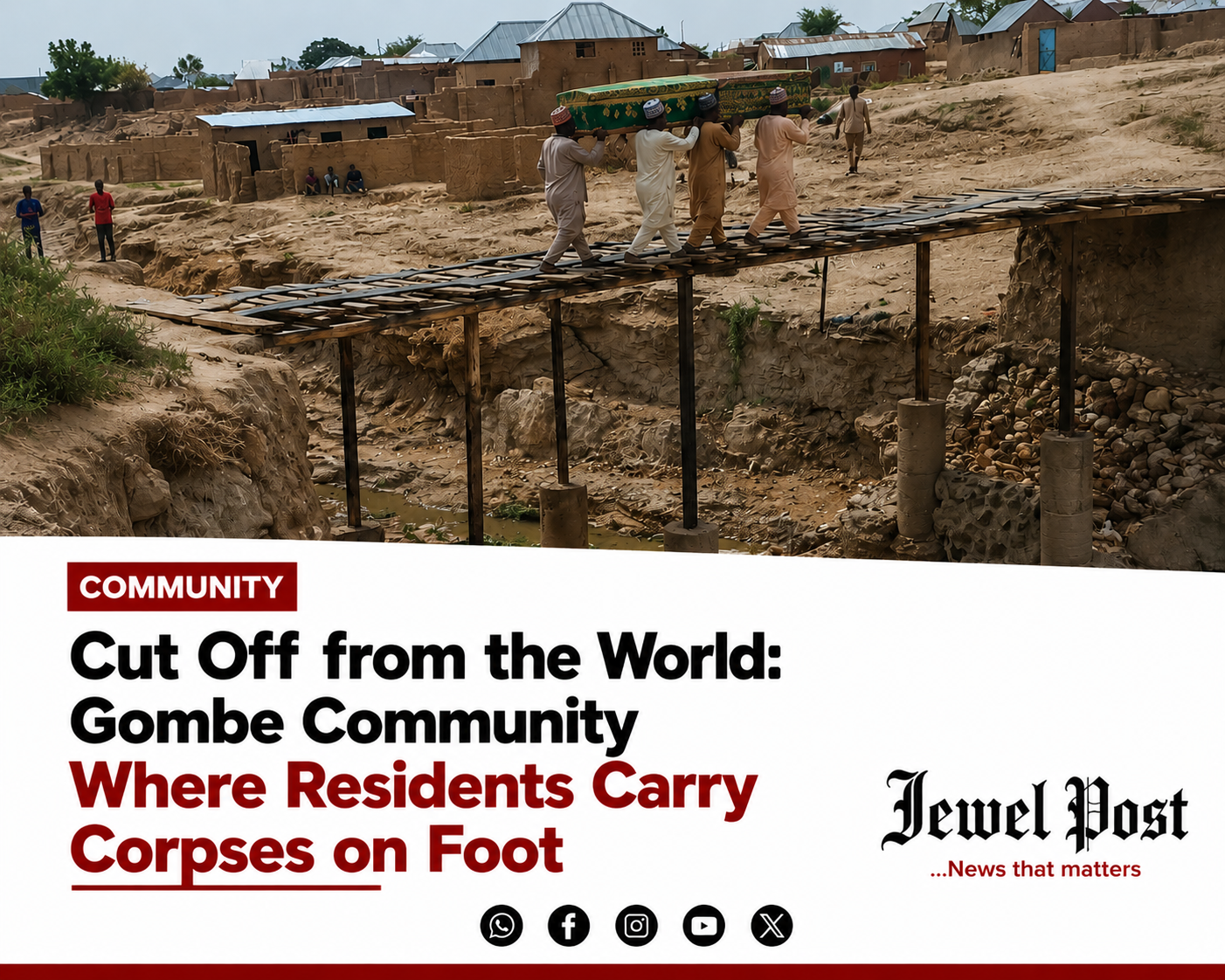
Cut Off from the World: Gombe Community Where Residents Carry Corpses on Foot
By Abubakar Rabilu
For residents of the Afghanistan community in Garko Ward of Akko Local Government Area of Gombe State, the arrival of the rainy season signals not relief but hardship, fear and isolation.
Whenever heavy rainfall occurs, the only road leading into the community becomes flooded and impassable, while a fragile wooden bridge serving as the settlement’s lifeline turns into a dangerous crossing point, cutting off thousands of residents from the outside world.
For years, community members have endured the situation, hoping for government intervention. But with no sign of improvement, many say they feel abandoned and forgotten.
A visit by our correspondent revealed a severely eroded access road riddled with deep gullies and a deteriorating wooden bridge constructed and maintained largely through communal efforts.
Residents said that once floodwaters overtake the road, movement is nearly impossible, leaving traders, students and workers stranded for hours or even days.
Malam Saleh Maina, a resident, described the condition as unbearable.
“When the rain is heavy, the community becomes completely cut off. People returning from work or the market sometimes have no option but to sleep outside because there is no way to cross into the village,” he said.
According to him, the bridge currently serving the community has never received government attention.
“The bridge was built through community efforts. Whenever it gets damaged, residents contribute money to repair it because we cannot afford to remain isolated,” he said.
Maina lamented that, despite the rapid expansion of the settlement, residents still lack basic amenities, including good roads, electricity, potable water, and healthcare facilities.
“We have repeatedly appealed to authorities and political representatives, but nothing has changed. We supported successive governments and voted during elections believing our voices would be heard, but we still feel neglected,” he added.
Another resident, Isiyaku A. Dauda, popularly known as Ziyara, said the bridge has become a major threat to lives and livelihoods.
“This bridge is our only connection to the outside world. Once it becomes impassable, everything comes to a halt, he said.
He explained that motorcycles and tricycles are often the only means of transportation that can navigate the route, while cars and larger vehicles are unable to cross.
“For over nine years, we have relied on this wooden bridge without any intervention from either the state or local government. Whenever repairs are needed, residents go from house to house to raise funds,” he said.
He estimates that rehabilitating the bridge before the peak of the rainy season will cost more than N1.5 million.
One of the most troubling consequences of the poor infrastructure, residents said, is the difficulty of evacuating sick people and transporting the dead.
“Sometimes, even corpses have to be carried on foot because vehicles cannot cross the bridge,” Ziyara said.
Residents also decried the lack of healthcare facilities and access to safe drinking water, noting that women and children bear the greatest burden.
Ibrahim Usman, another resident, stated that accessing medical care during emergencies is often a daunting task.
“If somebody becomes seriously ill at night, taking the person to hospital is a major challenge because vehicles cannot enter the community,” he said.
The village head of the Afghanistan community, Muhammad Bello Banbulasta, said more than 4,000 people live in the settlement, yet it remains without basic infrastructure.
He recalled a tragic incident involving a tricycle rider who reportedly fell from the bridge while transporting a pregnant woman to hospital.
“Sadly, lives were lost. Pregnant women are among those who suffer most whenever the road becomes inaccessible,” he said.
Banbulasta also lamented the absence of a polling unit in the community, saying it contributes to the area’s neglect.
“Without a polling unit, politicians often forget that people live here,” he said.
The village head appealed to the Gombe State Government, elected representatives and relevant agencies to urgently construct a standard bridge and access road to end the community’s decades-long hardship.
“What we are asking for is basic infrastructure that will allow our people to live normal lives. We are not asking for too much,” he said.
Residents warned that if the situation continues unattended, they may resort to peaceful demonstrations to draw attention to their plight.
Efforts to obtain comments from the member representing the area in the Gombe State House of Assembly, Musa Muhammad Wuro Biriji, were unsuccessful.
Attempts to get the reaction of the Gombe State Ministries of Works and Environment also failed, as both ministries are currently being overseen by permanent secretaries following the absence of commissioners in the state.
