




North-East Stakeholders Seek Inclusion of Almajiri in Development Policy
By Najibullah Adamu
Stakeholders from across the North-East have demanded that the Federal Government mainstream child welfare, especially for Almajiri children in the draft National Regional Development Policy, NRDP, 2026-2030.
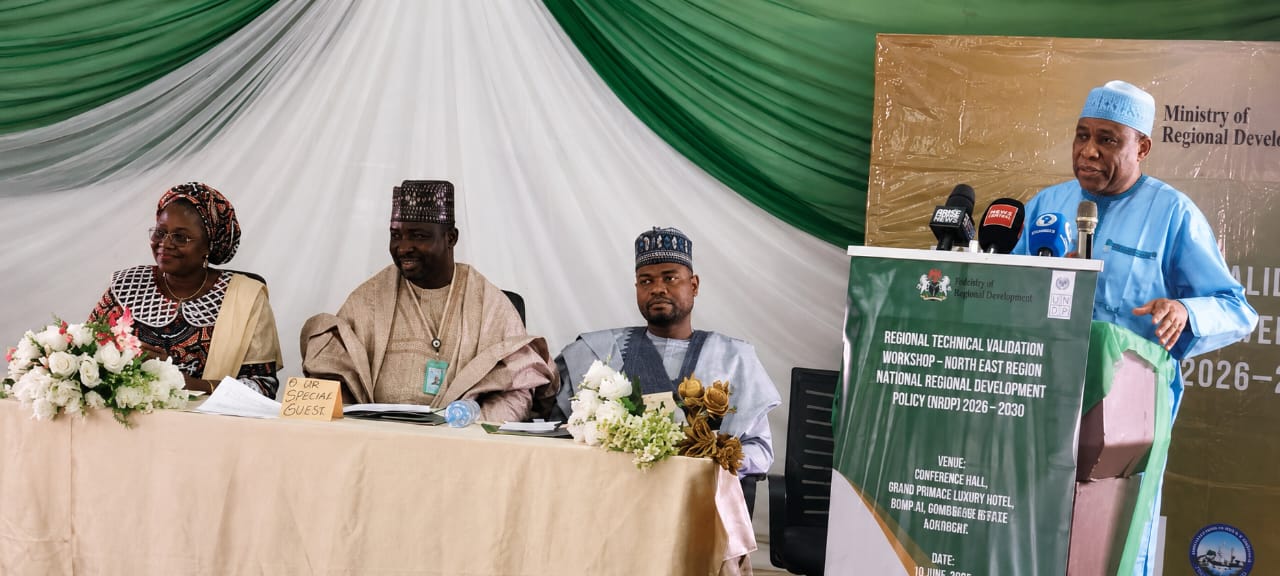
The demand was one of 13 resolutions contained in a communique at the close of a validation workshop organised by the Federal Ministry of Regional Development with support from UNDP in Borno State, a copy issued to our correspondent over the weekend.
According to the communique, the North East Development Commission (NEDC) and other Federal and State Ministries Departments and Agencies “were urged to mainstream child welfare, especially for Almajiri children, while providing accessible infrastructure and services for PWDs and other marginalised groups across all programmes.”
It warned that without addressing ‘Almajiri’ needs, children would remain denied basic care, education and economic empowerment, while abuse, child labour and poverty would persist.
Beyond inclusion, stakeholders called for stabilisation through targeted humanitarian response to restore human dignity to be prioritised in the policy.
To tackle persistent insecurity, the workshop resolved that a Regional Security Network should be made a full Pillar of the regional development policy.
“The proposed network would establish grassroots/community security and surveillance groups to complement federal security architecture”, it says.
Recognising the Sahelian reality of the region, participants also resolved that climate-vulnerable areas must receive climate adaptation financing and ecosystem restoration support tied to smart agriculture to build resilience.
The stakeholders further insisted that needs assessment must be carried out during project conception so interventions reflect real community needs.
They also urged stronger synergy between Federal, State and Local Governments to develop energy, transportation and communication infrastructure.
The communique also called for the recharging of Lake Chad, establishment of Agricultural Hubs, Industrial Parks, Mineral Processing Plants and Skills Acquisition centres.
Mohammed Goni Alkali, the Managing Director of the North-East Development Commission, NEDC, said the NRDP was a critical step toward addressing regional imbalance.
He noted that the North-East has a 74 percent poverty index, the second highest in the country, and that only two in ten residents have access to power.
“The Commission was established to tackle poverty and rebuild the North-East, and since its inception it has been intervening across many sectors,” Alkali said.
He urged participants to ensure the policy reflects the aspirations and context of the region so interventions would be targeted and sustainable.
Dr. Mary Ogbe, the Permanent Secretary, Federal Ministry of Regional Development, said the Federal Government was in the final stages of developing the NRDP 2026-2030.
Ogbe explained that the Ministry, in collaboration with UNDP, was holding workshops across the six geopolitical zones to obtain inputs before submitting the document to the Federal Executive Council for approval.
She said the north-east workshop was designed to review the post-technical draft, align regional priorities with state plans, clarify institutional roles and validate financing and monitoring frameworks.
The Permanent Secretary added that the session was expected to secure subnational endorsement prior to national consolidation.
The workshop brought together institutions, civil society organisations, the private sector, academia and development partners from the six North-East states to review the consolidated Draft NRDP Volume III.
